


 News Desk
काठमाडौं ─ २५ जेठ २०७९
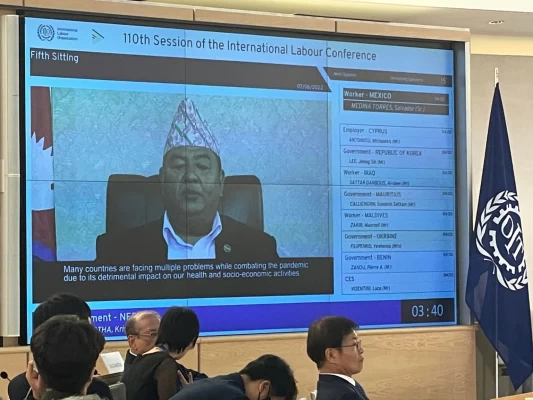
काठमाडौं, श्रम, रोजगार तथा सामाजिक सुरक्षामन्त्री कृष्णकुमार श्रेष्ठले सबै प्रकारका बालश्रम, बाध्यात्मक श्रम, मानव बेचबिखन तथा आधुनिक दासत्व पूर्णरूपमा उन्मूलन गर्न नेपाल सरकार प्रतिबद्ध रहेको बताउनुभएको छ । स्वीट्जरल्याण्डको जेनेभामा जारी ११० औँ अन्तर्राष्ट्रिय श्रम सम्मेलनलाई मंगलबार ‘भर्चुअल’ रूपमा सम्बोधन गर्दै उहाँले सन् २०२५ सम्ममा सबै प्रकारका बालश्रम उन्मूलन गर्ने लक्ष्यका साथ सरकारले काम गरिरहेको बताउनुभयो । आप्रवासनसम्बन्धी विश्वव्यापी समझदारीपत्रको भावनाअनुसार नेपालले नीति निर्माण अगाडि बढाइरहेको जानकारी दिँदै उहाँले गन्तव्य तथा सम्बद्ध मुलुकले आप्रवासी कामदारको मानवअधिकार तथा समानताको सुनिश्चितता गराउनुपर्नेमा जोड दिनुभयो । मन्त्री श्रेष्ठले रोजगारी सिर्जना, सामाजिक सुरक्षा तथा औद्योगिक सुरक्षाको बारेमा नेपालले गरिरहेको प्रयासबारे सम्मेलनलाई जानकारी गराउनुभएको थियो ।
नेपालले सन् २०१८ मा योगदानमा आधारित सामाजिक सुरक्षा योजना अगाडि बढाएको जनाउँदै उहाँले श्रमिक तथा उनीहरुको परिवारको कामसँगसम्बन्धी जोखिम न्यूनीकरण सम्बन्धमा सामाजिक सुरक्षा योजना महत्वपूर्ण कदम रहेको बताउनुभयो । सीमान्तकृत तथा बेरोजगार नागरिकलाई केन्द्रमा राखी सुरु गरिएको प्रधानमन्त्री रोजगार कार्यक्रमले अनौपचारिक क्षेत्रमा रहेका श्रमिक र महामारीमा रोजगारी गुमाएकालाई पनि केही मात्रामा सहयोग पु¥याएको उहाँको भनाइ थियो ।
President of the Conference,
Director General of the ILO,
Distinguished Delegates!
I am pleased to address this august 110th Session of the International Labour Conference and would like to thank the ILO for organizing it despite the world being in a difficult post-pandemic situation, where many fellow member countries are still struggling to deal with the threat posed by the COVID-19 pandemic. Please accept warm greetings from me and the people of Nepal.
Many countries are facing multiple problems while combating the pandemic due to its detrimental impact on our health and socio-economic activities. In such a difficult situation, the 110th session’s deliberation on decent work and the social and solidarity economy could not be more appropriate. I congratulate the Chairperson of the Governing Body and the Director General of the ILO for their comprehensive reports which accurately elaborate and address the current state of affairs in the world of work.
Mr. President,
Nepal has made significant progress in vaccinating its population in response to the COVID-19 pandemic but we continue to struggle with aftermath. A highlight has been slow recovery of our economy due to rising inflation driven by commodity prices which has added to cost of living for workers and operational costs for enterprises.
Government of Nepal has adopted various measures in response, but I would like to especially inform you on our prioritization of social protection, employment, and industrial relations.
The pandemic showed governments across our federal system that universal coverage of social security measures is essential. Introduced in 2018, our contribution based social security scheme was an important step forward to improve protection of workers and their families and addressing work-related risks.
Our flagship Prime Minister Employment Program was launched to provide 100 days of work as a minimum employment guarantee and a basic level of income protection against unemployment of deprived groups. The programme has expanded its scope to include workers in informal employment to alleviate some of the spike in unemployment during the pandemic. Looking ahead we are beginning to develop its public employment service component together with designing new vocational skills related policy and related structures to improve employment opportunities.
The pandemic has served to bring decent work deficits in the informal economy to light. We have completed a national diagnostic of informality as per provisions of Transition from the Informal to the Formal Economy Recommendation, 2015 (No. 204), and are currently developing an integrated national action plan through tripartite plus social dialogue.
I am pleased to you inform you that Government of Nepal has responded by conducting a systems assessment based on principles of Labour Administration Convention (No. 150) and have since begun structural reform in consultation with workers and employers to improve operational capacity and service delivery.
Mr. President,
I would like to inform you that the Government of Nepal is committed to ending all forms of child labour, forced labour, human trafficking, and modern forms of slavery. Our commitment is reflected in our membership of Alliance 8.7 and our role as a pathfinder country. We are also well on our way to implementing a master plan to eliminate all forms of child labour by 2025.
Nepal is working in line with the spirit of the Global Compact on Migration. We strongly believe that migrant workers deserve basic human rights and equality of treatment in the destination and transit countries. My delegation fully supports and appreciates the outcome document to be adopted in this Conference.
Before concluding, let me also take this opportunity to reiterate my country’s vow that vaccines are global public goods and, therefore, vaccine-governance should be fair to all. Nepal is effortful to overcome the fight against the pandemic and looks forward to a continued and enhanced cooperation with the ILO.
I wish every success of this Conference. Thank you.