

 News Desk
- Saroj Ojha
The democratic movement of Nepal has been a long and arduous journey, marked by various phases of struggle against autocratic rule, political oppression, and social inequalities. Over the years, Nepal has experienced a significant transformation from the autocratic monarchy to a democratic republic.
Out history has been marked by a feudal monarchy that lasted for centuries. After Nepal' s unification the Shah dynasty ruled Nepal from 1768 until 2008, whereas Autocratic Rana Regime ruled Nepal for 104 years, during which political oppression were common. Absence of basic civil liberties and human rights fueled discontent among Nepali citizens, paving the way for a popular uprising and the eventual establishment of democracy.
Nepal's political landscape witnessed a significant change with the overthrow of the Rana regime in 1951. The Ranas, who ruled Nepal for over a century, held absolute power and squashed any opposition. The democratic movement gained momentum with the leading contribution of Nepali Congress Party including Praja parisad, communist party, some revolutionary social campaigners and the king Tribhuvan. The charge against the Rana autocracy in a continuous way the eventually ousted 104 year long Rana regime in 1951 (2007 Falgun 07) , making way for Nepal's transition to a democratic system.
The immediate post-Rana era witnessed a democratically elected government with King Tribhuvan appointed as the ceremonial head of state. However, political instability marred the fledgling democracy. Internal power struggles, friction between political parties, and the monarchy's continued influence hindered the consolidation of democratic institutions. The first elected government, led by Prime Minister B.P. Koirala, faced constant challenges, including a coup attempt in 1960 that led to the suspension of democracy for several decades.
Following the suspension of democracy in 1960, King Mahendra, Tribhuvan's successor, abolished the parliamentary system and introduced the Panchayat system in 1962. This system maintained the monarchy's stronghold on power, with the king having the final authority in all matters. The Panchayat system aimed to provide stability and development, but it severely curtailed civil liberties and political freedoms. Dissent was suppressed, and the king's rule remained unchallenged for years.
The democratic movement resurfaced in the 1980s, driven by a wave of pro-democracy protests and growing discontent with the authoritarian rule of King Birendra. The pro-democracy movement gained momentum in 1990, with widespread protests demanding the restoration of democracy. These protests, collectively known as the People's Movement, ultimately led to the reinstatement of a multi-party democracy in Nepal. Nepal's transition to democracy was set off by the People's Movement of 1990, Following mass protests, King Birendra was compelled to abandon the partyless Panchayat system and institute a multi-party parliamentary democracy. This marked a significant turning point in Nepalese history as it laid the foundation for the country's democratic future.
The new Constitution of 1990 established Nepal as a parliamentary democracy and marked the end of the Panchayat era
However, the initial years of the journey towards a stable democracy was far from over. Frequent changes in government, corruption, and struggles for power between different political parties characterized this period. The shah monarch still held considerable power, and the Maoist insurgency that began in 1996 further exacerbated the fragile political
Starting in 1996, the Communist Party of Nepal (Maoist) launched an armed insurgency against the government, revolution with the objective of overthrowing the monarchy and establishing a communist state. The insurgency claimed thousands of lives, brought the country to the brink of civil war and fueled political instability. In 2006, a Comprehensive Peace Agreement was signed between the government and the Maoists, leading to a ceasefire and the subsequent integration of former combatants into the national security forces. This agreement established the foundation for a democratic republic and initiated the process of arms management, peace building. So far, being a harsh period with human calamities maoist insurgency has even contributed to pitch the social reforms.
In 2008 Nepal officially transitioned from a constitutional monarchy to a federal democratic republic . The monarchy was abolished, and a Constituent Assembly was elected to draft a new constitution that would address the aspirations of Nepal's diverse ethnic, linguistic, and cultural groups. However, the constitution drafting process was marred by disagreements and protests, leading to political impasses and delays. Finally the country adopted a new constitution in 2015, aiming to ensure a stable political structure and address the demands of various ethnic, linguistic, and cultural groups.
However, the journey towards stability and governance in Nepal remains a challenge. Political polarization, corruption, and Social inequities persist, impeding the effective functioning of democracy. Where as, widening socioeconomic disparities continue to hinder the establishment of effective democratic institutions. Additionally, periodic disputes over power-sharing and territorial delineation among the newly formed provinces pose additional challenges. Disputes over power-sharing, territorial delineation among provinces, and adequate representation of marginalized communities pose challenges to political stability and governance.Despite these hurdles, Nepal has made significant strides towards consolidating its democratic institutions
Regular elections at the local, provincial, and federal levels have taken place, contributing to the decentralization of power and fostering citizen participation. Engagement with international organizations and investments in infrastructure development have also helped in stabilizing the country.
Nepal's transition from an autocratic monarchy to a democratic republic has been a remarkable journey, fraught with challenges and obstacles.
The country has experienced moments of triumph as well as setbacks on the path towards consolidating democracy. But we still grapples with issues of corruption, poverty, and a lack of effective governance. The journey continues, with ongoing efforts needed to address the challenges of corruption, social inequalities, and governance.
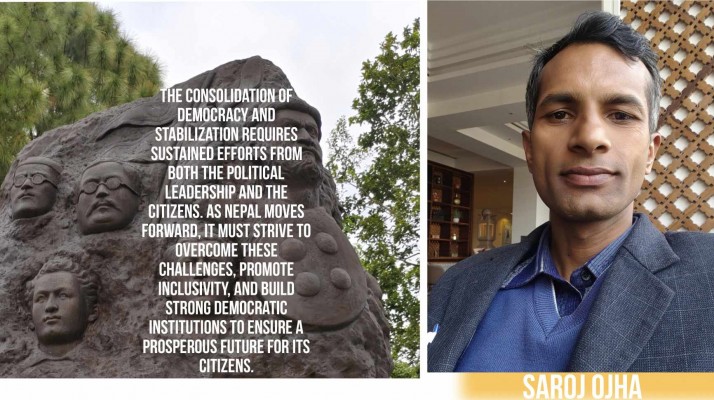
The consolidation of democracy and stabilization requires sustained efforts from both the political leadership and the citizens. As Nepal moves forward, it must strive to overcome these challenges, promote inclusivity, and build strong democratic institutions to ensure a prosperous future for its citizens. Only through the collective perseverance of political leaders and engaged citizens can Nepal achieve a stable and inclusive democracy that upholds the rights and aspirations of all its people.